Off the ticker — Japanティッカーに載らない日本の話
When a free teacup becomes contraband
A sushi chain gave away cups with a small cartoon creature on them, the kind nobody can quite classify. Three days later it called off the whole campaign, saying it had found misconduct by one of its own staff. What follows is what the documents say, and what they say about the country whose news you came here to watch.
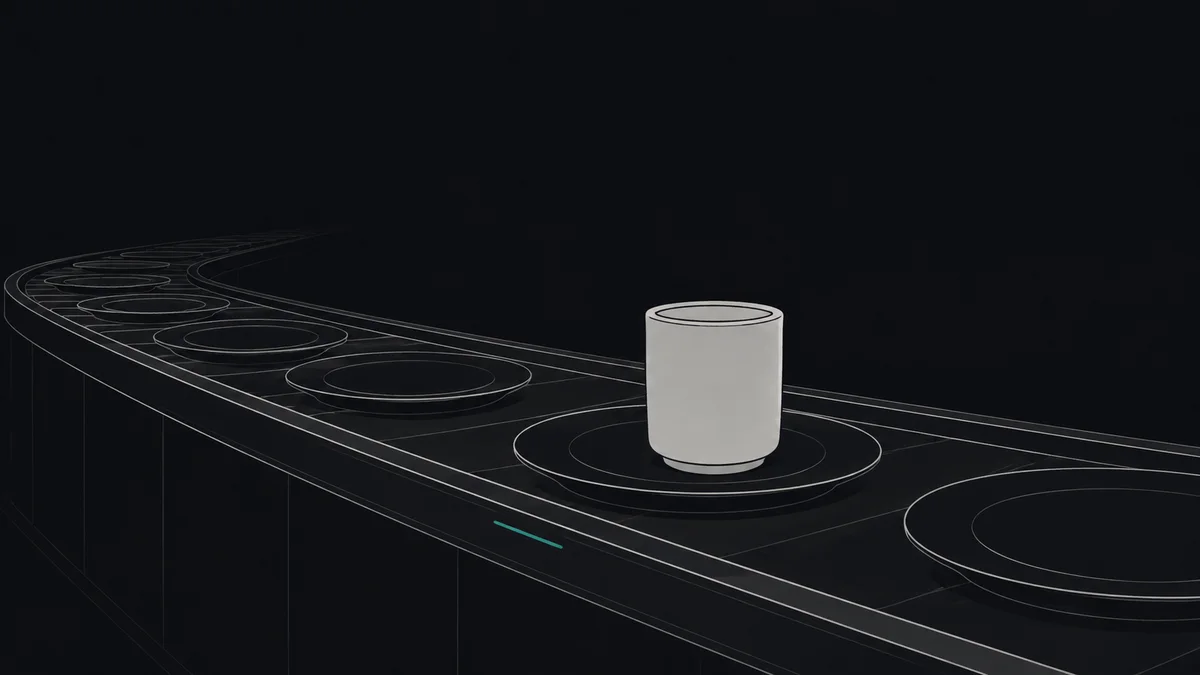
Kura Sushi runs 687 restaurants. On Saturday it published a one-page notice saying that from opening time on Sunday, 6 September, it was cancelling its collaboration with Chiikawa: the giveaways, the lottery prizes, the two special menu items, the in-store decorations, all of it. The stated reason, in the company’s own words, was that its investigation had found “misconduct by an employee of the company” in connection with running the campaign.
Let me be honest about the scale first. Nobody was hurt. Nobody has reported being out of pocket, and the company has not announced compensation for anyone. The object at the centre of it is a teacup you got free with a meal. The news post I first saw it in had passed four million views a few hours after the notice went up.
What was actually cancelled
The notice lists six things. Read the list, because it is the shape of the whole business model:
- Lottery prizes: a figure, an acrylic magnet, a can badge
- The original teacup giveaway
- The original sushi-plate giveaway
- A receipt-entry draw for an apron (fifty winners)
- Two collaboration dishes named after things in the comic: agedakko sauce noodles and Usagi’s pancake
- The in-store video and the decorations at three restaurants, one of them the Harajuku flagship
Item one is the part a visitor notices first. Every five plates you finish buys you one go on a machine at your table called Bikkura Pon, which decides whether a capsule drops. Children stack plates with the focus of professional gamblers. The prize inside costs the company very little, and the company does not sell it.
Item two was two days old. The teacups came in four designs, one per ¥3,000 of spending, a million units planned, and the handout started on 4 September. The sushi plates in item three were due on the 18th. Now they will not happen at all.
Three days, start to finish
On 2 September the company posted a notice headed “Regarding certain social-media posts about the Chiikawa collaboration.” It said it was taking the posts “very seriously” and was “swiftly advancing an investigation into the facts.” Three days later it published the cancellation.
The 2 September notice contains a paragraph I keep going back to. Explaining how prizes are handled, the company wrote that under its internal rules the premiums are, as a principle, “stored in a locked warehouse,” with “opening and restocking done by more than one person” and a named person responsible. Improper handling or taking, it added, “is not tolerated at all.”
Read that again from outside Japan. A restaurant company listed on the Tokyo exchange is publishing its chain-of-custody procedure for free cups. It wrote that procedure because it needed one.
The law that makes the free thing cheap
The part that gets left out of the foreign version of this story is the law, and the law explains more than any amount of cultural commentary.
Japan regulates giveaways. Under the Act against Unjustifiable Premiums and Misleading Representations, a gift handed to everyone who buys, or to whoever gets there first, is a sōzuke premium, and the Consumer Affairs Agency caps what it may be worth: ¥200 where the purchase is under ¥1,000, otherwise two-tenths of the purchase price. Spend ¥3,000 and the cup you take home may be worth ¥600, not a yen more.
A prize won by chance sits under a different ceiling, and the plate machine is a lottery. For a purchase under ¥5,000 the prize may be worth twenty times the transaction. The law is generous to luck and strict with certainty.
That fixes the economics of a Japanese restaurant giveaway before any marketer touches them. The guaranteed object has to be cheap. What it is worth to the person who wants it comes from the fact that nobody can buy one: you turn up, this month, while stocks last, or you go without. Scarcity here is the residue of a consumer-protection statute.
Scarcity has a market. Reporting on the days before the cancellation described two things going round: customers posting that they had opened capsule after capsule without a single figure, and complaints that particular prizes were showing up in bulk on flea-market apps. The company has not published what its investigation found, so I am not going to join those dots for you. Both complaints are about the same gap, between what a premium costs to make and what someone will pay for one.
Honestly, this is where the design falls short
I have spent enough time near an inspection bench to guess how this goes, and it rarely starts with greed at the top. You take a million cheap objects that people badly want, move them through hundreds of restaurants on ordinary shifts, and ask staff to treat a ¥600 cup as if it were worth what a collector would pay, which from inside the box it plainly is not. You can write a locked-warehouse rule. Somebody still has to open the warehouse every morning.
The warning was on file. In July 2025, during the previous Chiikawa campaign, the company published a notice saying sales of the prize-linked sets had “far exceeded plan” and were suspended, and that some restaurants would switch to other prizes as stock ran out. That is a document about demand outrunning supply. A year later, same franchise, bigger stakes.
Cancelling everything, down to the pancake and the decorations in three restaurants that had done nothing wrong, is a heavy instrument. I think it was the only one left. Once people suspect the guaranteed gift was not guaranteed, the chain has nothing to hand a customer except an apology.
What nobody has said
- What the misconduct was. The notice does not describe it. How many people, which restaurants, what happens to them: none of that is public, and neither is any police involvement.
- Anything from the rights holder. Chiikawa’s official information site, which lists its tie-ups the way an airline lists destinations, carried no statement about this when I looked on 5 September, and no Kura Sushi entry either.
- Anything to the television. The cancellation notice contains one gloriously bureaucratic sentence: the TV commercials are still telling viewers the campaign is running, but the campaign is over. Somewhere a media buy is outliving the thing it sells.
Why a teacup gets this much air
Chiikawa is a web comic by an artist who publishes as Nagano, serialised on social media since January 2020 and animated since 2022. The creatures in it are small, and they work. To earn money they take jobs handed out by the armoured ones: weeding, and hunting, which can kill them. Then they eat something and feel better. That may be why the tie-in list reads like an index of Japanese life: an airline, a beer company, the professional football league, a baseball club, a credit card, a discount chain, the observation tower, an overnight ferry.
A collaboration here is a reason to go somewhere on a Tuesday. The premium is the product and the meal is the delivery mechanism. So when the premium leaks, the chain is not owning up to a merchandising error. It is telling you that the reason you came was not in the building.
Decide for yourself whether a country that spends a weekend on this is complacent, or has its thresholds set somewhere else. I would resist the flattering version, the one where nothing worse happens in Japan. Plenty does. This one involved a cup, and it was disclosed in three days with the paperwork attached.
Watch it land
This is the kind of item that runs near the end of an evening bulletin, after the weather. If you want to see how a Japanese newsroom handles it, the Japanese broadcasters on this site are all the broadcaster’s own official channel: ANN (TV Asahi), NTV News, TBS NEWS DIG, FNN Prime Online, Kyodo News, and NHK WORLD-JAPAN in English. Or open the full channel list and filter by Japan.
Sources
- Kura Sushi Inc., notice of cancellation of the Chiikawa collaboration campaign (PDF, 5 September 2026) and notice regarding certain social-media posts (PDF, 2 September 2026). Both linked from the company's news page.
- Kura Sushi Inc., corporate profile — 687 restaurants as of 31 October 2025, including 79 in the United States and 60 elsewhere in Asia.
- Kura Sushi Inc., notice on Chiikawa-related goods (PDF, 24 July 2025) — the previous campaign's stock shortfall.
- Consumer Affairs Agency, Outline of premium regulation — definitions and value ceilings for lottery and non-lottery premiums.
- ORICON NEWS, report on the two-day teacup giveaway and report on the sequence of events (5 September 2026) — campaign dates, quantities, and the note that the nature of the misconduct has not been disclosed.
- Chiikawa Info (Spiral Cute), official information site — viewed 5 September 2026 for the tie-up listing.
All figures and quotations were taken from the pages linked above on 5 September 2026 (Japan time). Company statements are the company's own; where an account comes from press reporting rather than a primary document, it is described as such above. Wording in English is our translation of the Japanese originals.